How to Compare Flooring Installation Quotes: A Side-by-Side Guide
A step-by-step framework for lining up two or three flooring installation quotes side by side, normalizing line items, and picking the best value — not just the lowest price.
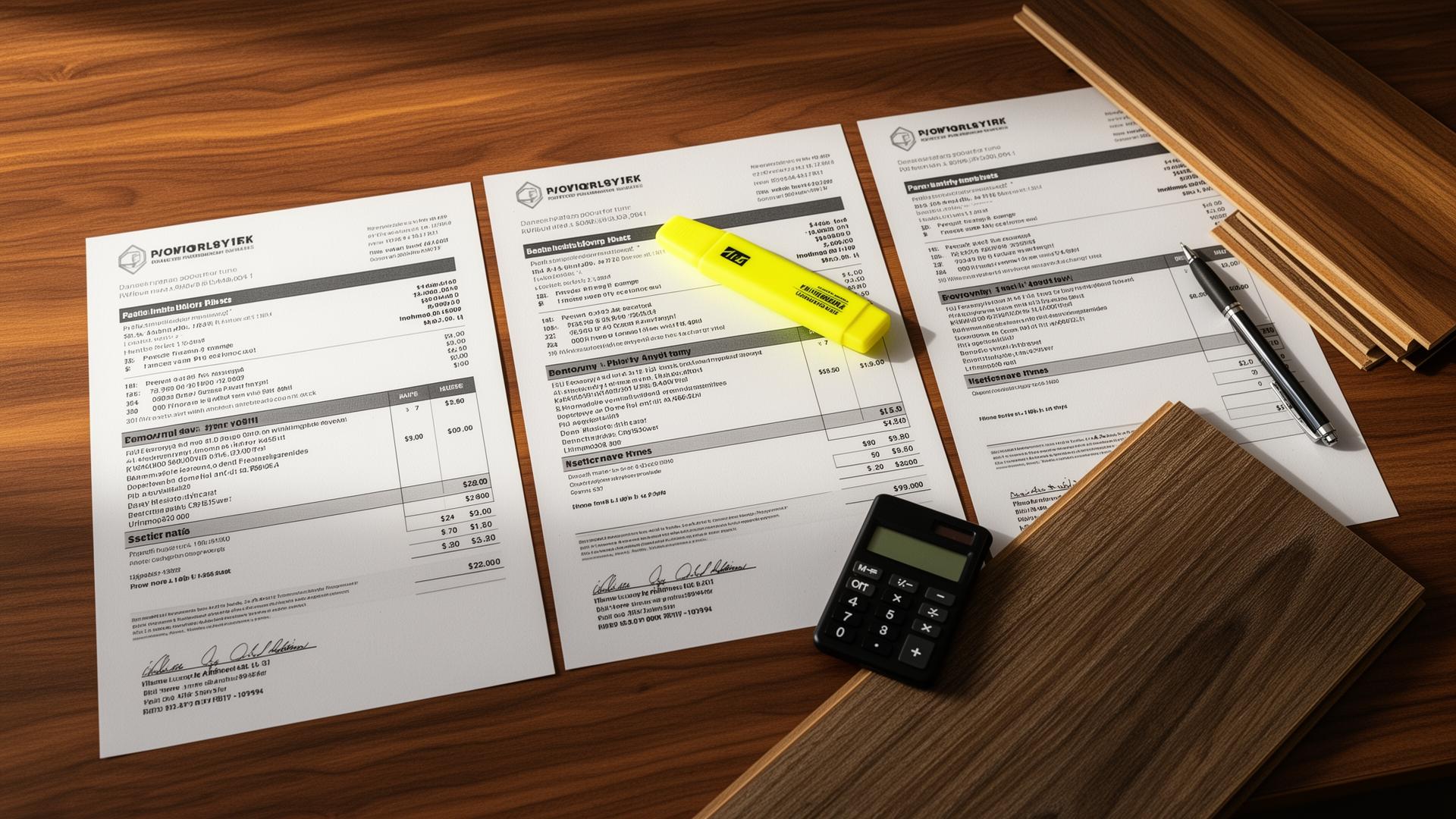
You collected three flooring installation quotes. They all look reasonable. They all use different formats. One is $4,200, another is $3,800, the third is $4,650 — and somehow, the $3,800 quote ends up being the most expensive once the job actually starts. This is the most common (and most expensive) mistake homeowners make: comparing the bottom-line totals instead of comparing the scope. Here is the framework professional estimators use to compare bids apples-to-apples, in four practical steps.
Why comparing flooring quotes is harder than it looks
No two contractors format a quote the same way. One itemizes removal as a separate line. Another folds it into "labor." A third assumes you already pulled the carpet yourself. Add subfloor prep "allowances," vague baseboard handling, and stairs that may or may not be bundled into the sq-ft rate, and the totals you're comparing aren't really for the same job. Before you pick a winner, you need to normalize the bids so each one represents the same scope of work. That's the only way the dollar figures mean anything.
Step 1: Create a comparison grid (the 7 categories)
Open a notepad — or a spreadsheet if you prefer — and force every bid into the same seven buckets. It does not matter how the contractor structured their PDF. Your job is to translate.
- Removal / demo: Carpet pull, tile demo, vinyl scrape, glue removal. Each priced per sq ft (they cost very differently). Note: who hauls it away?
- Subfloor prep: Leveling compound, patching, screw-down, moisture mitigation. Is it a fixed price or an allowance? (We'll come back to this.)
- Installation labor: Per-sq-ft rate × total area. Confirm the install method is named (glue-down, floating, loose-lay) — see our subfloor readiness guide.
- Transitions & trim: T-moldings, reducers, quarter round, baseboard removal/reinstall. Each counted and priced.
- Stairs: Per-tread/riser rate, count of treads, nosing included? Stairs should never be lumped into the floor sq-ft total.
- Material: Who supplies the planks? If installer-supplied, list brand, SKU, qty, unit price. If customer-supplied, note it (the labor rate may be different).
- Furniture moving, haul-away, misc: Furniture moved by crew, debris haul-away, appliance disconnect, door undercutting, permits.
You now have a 3-column grid (one column per bidder) with seven rows. Fill in every cell from each quote PDF. Blank cells are the most important part — those are the omissions.

Step 2: Normalize the totals
This is the step that changes the answer. Pick the most complete bid as your baseline scope. Then, for every other bid, add back the missing line items at their fair market rate so all three quotes cover the same work.
A real-world example for a 1,200 sq ft LVP job:
- Bid A — $4,200 includes removal, prep allowance, labor, transitions, baseboard reinstall.
- Bid B — $3,800 includes labor and transitions only. No removal listed. No prep allowance. Baseboards "extra."
- Bid C — $4,650 includes everything Bid A has, plus a fixed stair price and 1-yr labor warranty stated.
Bid B looks cheapest. But add back removal (1,200 sq ft × $0.75 = $900), a $300 prep allowance, and baseboard reinstall (180 LF × $1.50 = $270), and Bid B's normalized total is $5,270 — now the most expensive of the three. Bid A is actually the best price. Bid C is $380 more than Bid A but includes a stated warranty and a fixed stair price. The math you do here is the whole reason this article exists.
Step 3: Check what each quote omits
A bid wins on price most often by quietly excluding scope. Run every quote through this 5-check omission test:
- Is removal priced? Or is it assumed already done? If you haven't removed your old carpet, this is your problem on install day.
- Is subfloor prep a fixed price or vague "as needed"? "As needed" with no rate is an open-ended invoice — see our quote line-item guide on when allowances are okay.
- Are transitions and baseboards explicitly addressed? "TBD" means change order.
- Is the labor warranty named? Length AND what it covers. "We stand behind our work" is not a warranty.
- Is there a payment schedule? A reasonable schedule is a deposit, a progress payment, and a final payment after walkthrough. 100% upfront is a red flag.
Each "no" is a risk vector. Score them.
Step 4: Score beyond price
Once your quotes are normalized, weight five factors — not just the dollar total:
- Price (normalized) — 30%
- Scope completeness — 25% (fewer omissions = higher score)
- Timeline — 15% (start date, estimated duration)
- Communication — 15% (responsiveness, clarity of quote, willingness to answer questions — covered in our vetting questions guide)
- Reviews & references — 15% (recent, local, and flooring-specific — not general handyman reviews)
A bidder scoring 85 on the non-price factors at 10% over the cheapest bid almost always delivers better net value than the lowest bid with vague terms. The "savings" on the cheap bid evaporate the first time you hit a change order. Here's why different installers charge different prices — it's almost never random.
Red flags that should disqualify a bid entirely
- No license or insurance mentioned (or evaded when you ask).
- 100% payment required before any work begins.
- No written warranty, or warranty under 1 year on labor.
- The quote is a single line: "Install LVP — $X." No breakdown.
- Significant scope described only verbally, not in writing.
These are not negotiables. A bidder who refuses to put scope in writing is telling you exactly how the job will go.
How TRU writes quotes
Every TRU Installation quote uses the same itemized format — the same seven categories above — so comparing us against any other bid is a one-page exercise. Our published rates are visible before you even talk to us, and we write a binding written quote after an on-site measurement. No mystery allowances, no "TBD" line items.
Start by building your own budget baseline with our instant estimate calculator, then book a professional measurement for a binding quote you can put next to any other bid. If you're still weighing where to buy and who to hire, our independent contractor vs big box guide and multiple quotes guide are worth reading next. For day-of-install scope, see what a professional installation includes.
Know your flooring cost in 60 seconds.
Use our published rates to get an itemized estimate — no phone calls, no sales pressure.
Keep reading
All articles →
How Much Does It Cost to Install Laminate vs LVP?
A side-by-side cost breakdown of laminate vs LVP — material, labor, and total installed price per square foot, plus which one actually saves money over 10 years.
What's Included in an LVP Flooring Installation Quote?
A line-by-line breakdown of a real LVP installation quote — what each charge means, what should be itemized, and the omissions that signal change-order trouble ahead.
What Does a Professional Flooring Installation Include?
A clear scope-of-work guide: every step a real flooring install should cover, what is usually excluded, and how to compare quotes line by line.