What's Included in an LVP Flooring Installation Quote?
A line-by-line breakdown of a real LVP installation quote — what each charge means, what should be itemized, and the omissions that signal change-order trouble ahead.
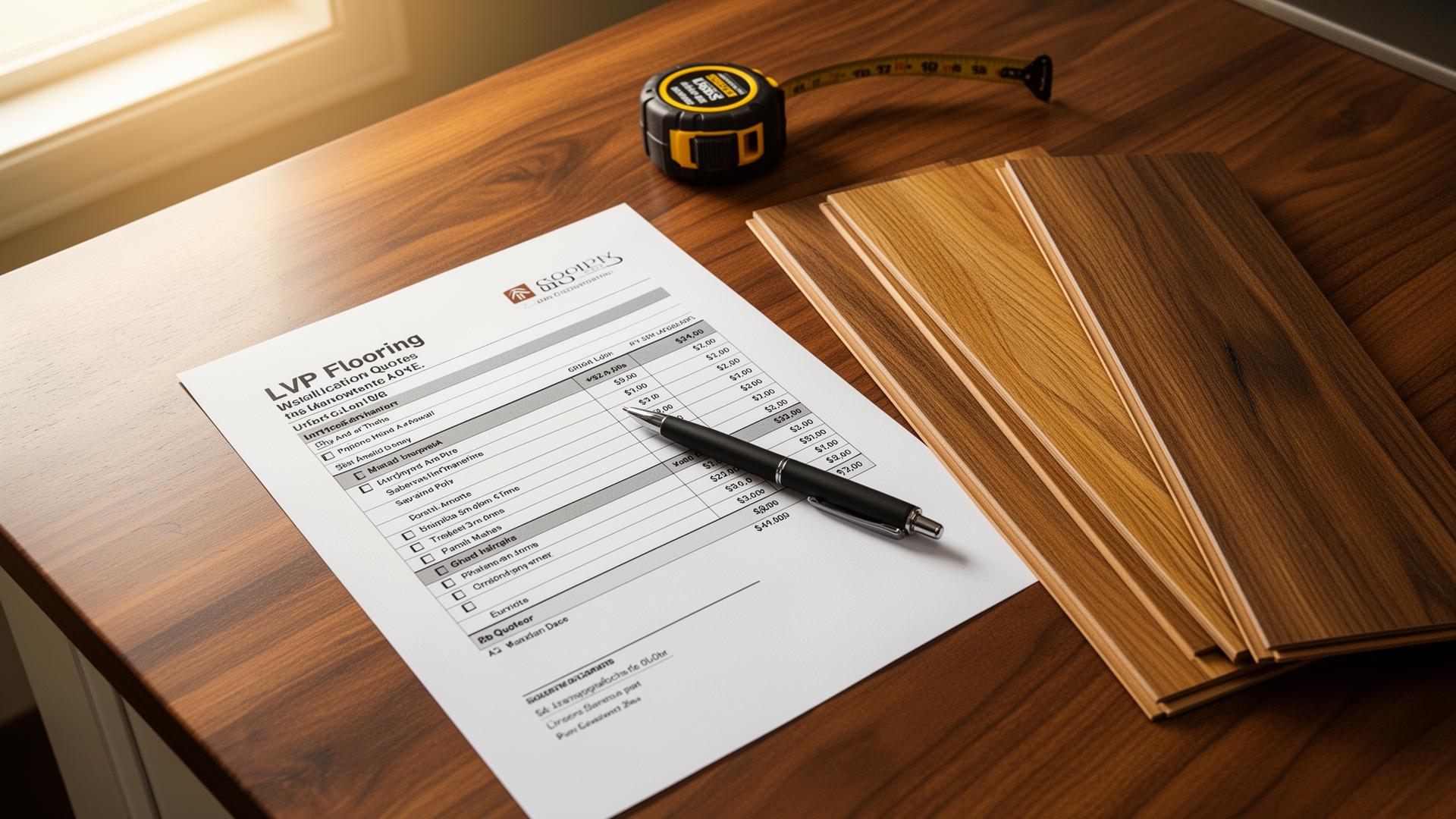
A flooring quote isn''t paperwork — it''s a preview of your contract. Vague quotes ("LVP install — $4,800 lump sum") turn into expensive surprises once the carpet comes up and the installer "finds" extra work. Itemized quotes let you compare bidders apples-to-apples, catch missing scope before signing, and walk into install day with no change-order anxiety.
Here''s exactly what should appear on a complete LVP installation quote, what each line means, and the five red-flag omissions to push back on before you sign anything.
The 9 sections every complete LVP quote should have
1. Project scope summary
The top of the page should name the address, the rooms being installed, total square footage, the product (brand, SKU, color, plank size, wear-layer mil), and the install method — glue-down, floating click-lock, or loose-lay. If the quote doesn''t name your product and method, the installer hasn''t committed to anything.
2. Material line
Planks, underlayment (if floating), adhesive (if glue-down), transitions, and trim. Each with brand, quantity, unit price, and line total. The quote should clearly state whether material is supplied by the installer or by you. If you''re supplying it, the quote should still list the SKU so there''s no confusion about what the labor price assumes.
3. Removal and demo
Carpet pull, tile demo, glued-down vinyl removal, and adhesive scraping all cost very different amounts. Carpet pull is typically the cheapest (around $0.50–$1.00 per sq ft including haul-away). Tile demo and glue scraping can run $2–$4 per sq ft. A quote that lumps "removal" into one number is hiding the fact that the installer hasn''t looked at what''s actually down there.
4. Subfloor prep
Leveling compound, patching, screw-down of squeaky spots, and moisture mitigation. A good quote names the standard the floor will be brought to — usually ¼" deviation over 10 ft for LVP, ⅛" for glue-down. It should also state what triggers extra cost: "Leveling beyond 2 bags of compound billed at $X per bag." For more on this, see our guide on how to know if your subfloor is ready for LVP.
5. Installation labor
The main line. Per-sq-ft rate × area, with the install method named (glue-down vs. floating) and the layout pattern noted if it''s anything other than a standard stagger — herringbone and chevron run 25–50% more in labor because of the cut waste and time.
6. Transitions and trim
T-moldings between rooms, reducers where LVP meets tile or carpet, quarter round at base, and shoe molding. Each piece should be counted and priced. Baseboard handling is its own line: removal, reinstallation, or replacement with new — at a per-linear-foot rate.
7. Stairs
Stairs are billed per tread and per riser, not by floor square footage. Expect $40–$80 per tread for LVP, more for stained-to-match nosings. If you have stairs and they''re not on a separate line, they''re going to become a change order.
8. Furniture moving and haul-away
The quote should state exactly what the crew will move (typically standard furniture in the install area) and what they won''t (pianos, gun safes, appliances, fish tanks, beds with stored items underneath). Haul-away of old flooring should be a named line item with a flat fee.
9. Totals, payment terms, and warranties
Labor subtotal, materials subtotal, sales tax (where applicable), grand total. The payment schedule (typically a deposit at signing, balance at completion — be wary of anyone asking for more than 50% upfront). And the labor warranty term in writing — one year is standard, two years signals a confident installer.
Sample line-item quote: 1,200 sq ft LVP job
Here''s what a clean, itemized quote looks like for a typical Southern California single-story home — carpet removal in living areas, LVP throughout, baseboards reinstalled:
| Line item | Qty | Rate | Total |
|---|---|---|---|
| Carpet removal & haul-away | 1,200 sq ft | $0.75 | $900 |
| Subfloor prep allowance (leveling, patching) | — | — | $300 |
| LVP installation — floating click-lock | 1,200 sq ft | $2.50 | $3,000 |
| Transitions (T-mold, reducer) | 6 | $35 | $210 |
| Baseboard removal & reinstall | 180 LF | $2.00 | $360 |
| Quarter round (new, primed) | 180 LF | $3.00 | $540 |
| Furniture moving (standard) | — | — | Included |
| Labor subtotal | $5,310 |
Rates above are illustrative. See our published price list for current TRU rates.
5 red-flag omissions to push back on
- "Subfloor prep as needed" with no rate. Means: you''ll pay whatever they decide on install day, and you have no leverage.
- Transitions not listed. Means: doorways and room edges become a change order, or your floor gets a raw cut edge against the tile.
- Baseboards not addressed. Means: either they''re leaving a gap at the base, or removal/reinstall shows up later at $3–$5/LF you didn''t plan for.
- Stairs lumped into floor sq ft. Stairs cost 5–10× more per "square foot" than open floor. If they''re hidden in the floor line, the price is wrong.
- No labor warranty term named. Means: when a plank lifts at month four, you''re on your own.
Allowances vs. fixed prices — when each is okay
An "allowance" is a placeholder dollar amount for work that can''t be fix-priced until something is exposed. A subfloor prep allowance of $200–$500 is normal and honest — no one can quote leveling on a slab they haven''t seen. The rule: allowances should be a small fraction of the quote, with a named billing rate for overage. If half the line items are allowances, the installer is shifting all the risk to you. That''s a re-quote, not a negotiation.
What''s usually NOT in the quote (and shouldn''t be)
A few things normally fall outside a flooring quote and are your responsibility to arrange: building permits (rare for LVP), plumbing disconnect/reconnect for toilets, appliance disconnect (gas line for ranges), paint touch-up on baseboards after reinstall, door undercutting beyond the standard couple of interior doors, and asbestos testing if your home was built before 1980 and has existing sheet vinyl. For the full picture of what an install day includes, see what a professional flooring installation includes.
How TRU Installation writes a quote
Every TRU written quote uses the line-item format above — no lump sums, no "as needed," no surprise stairs charge. The flow:
- Build a self-serve estimate with our instant calculator using your square footage and add-ons. You get an itemized number on the spot.
- Book a professional measurement for $100 (credited toward your job). We measure on-site and convert the estimate into a binding written quote you can compare against any other bid in town.
- Compare and choose. If a competing quote is cheaper but vague, line it up against ours item-by-item. The difference is almost always missing scope, not better pricing.
Want to read more before you book? See our guide on whether to get multiple flooring quotes, questions to ask a flooring contractor, and independent contractor vs. big box store.
Know your flooring cost in 60 seconds.
Use our published rates to get an itemized estimate — no phone calls, no sales pressure.
Keep reading
All articles →
How Much Does It Cost to Install Laminate vs LVP?
A side-by-side cost breakdown of laminate vs LVP — material, labor, and total installed price per square foot, plus which one actually saves money over 10 years.
How to Compare Flooring Installation Quotes: A Side-by-Side Guide
A step-by-step framework for lining up two or three flooring installation quotes side by side, normalizing line items, and picking the best value — not just the lowest price.
What Does a Professional Flooring Installation Include?
A clear scope-of-work guide: every step a real flooring install should cover, what is usually excluded, and how to compare quotes line by line.