Should I Get Multiple Quotes for Flooring Installation? A Homeowner's Guide
Yes — three itemized quotes is the sweet spot. Here is how to compare flooring bids beyond the bottom line, plus the red flags that turn a low bid into the most expensive option.
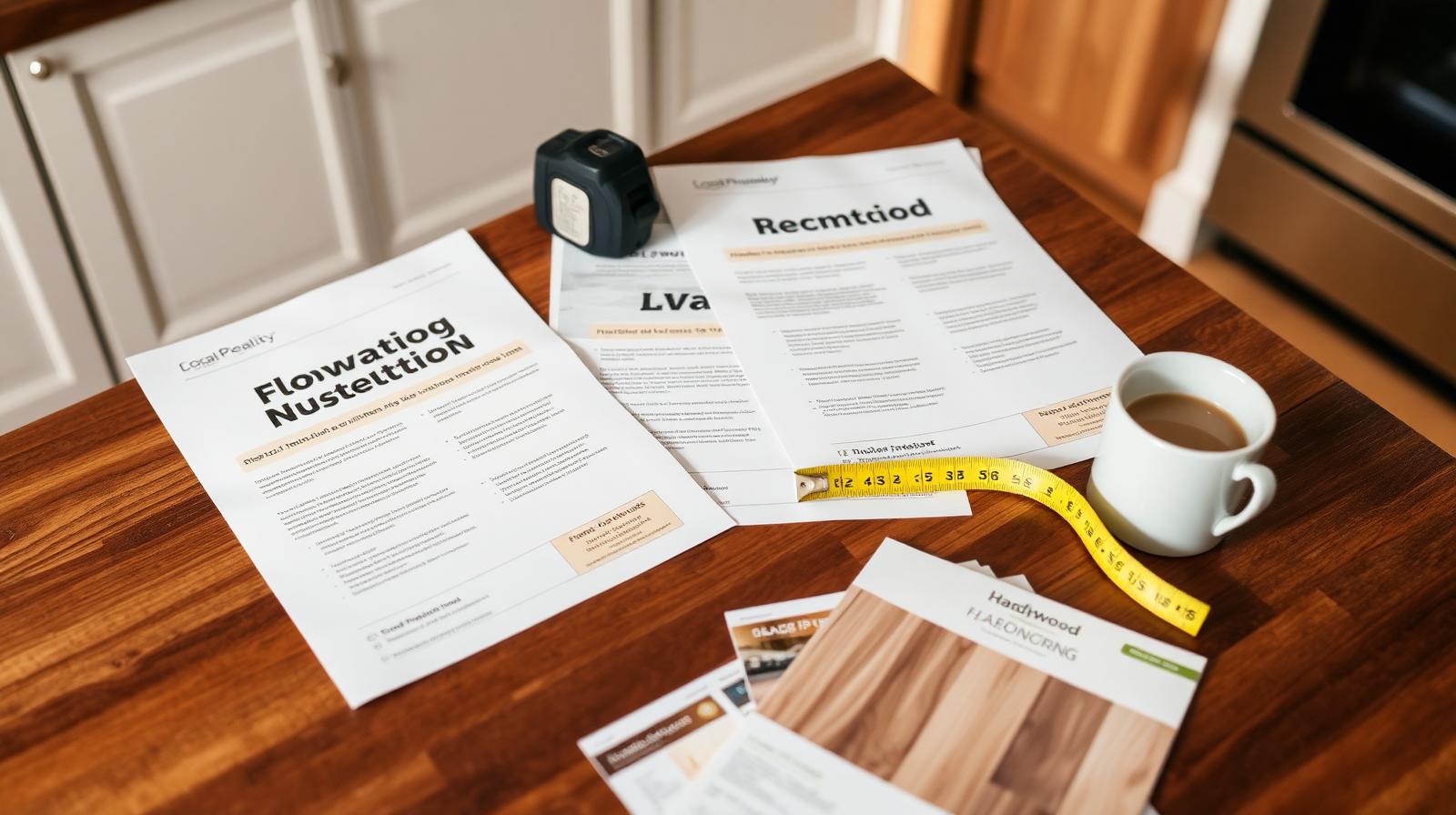
Short answer: Yes. Get three written, itemized quotes for any flooring installation over a few hundred square feet. One quote gives you no context. Two leaves you guessing. Three creates a pattern you can actually trust — and reveals the hidden assumptions that make bids vary by thousands of dollars on the same exact job.
Below is exactly how many quotes to collect, what to compare line-by-line, and why the cheapest bid is almost always the most expensive floor you will ever own.
Why multiple quotes matter for flooring specifically
Flooring is not a commodity. Two licensed installers can walk the same 1,000 square foot living room and write quotes $4,000 apart — not because one is "ripping you off," but because they are quoting different scopes of work.
One installer assumes your slab is flat. The other measures it and budgets for self-leveler. One quotes glue-down. The other quotes floating with underlayment. One includes baseboard removal and reinstall. The other expects you to handle it. Without three data points, you have no way to spot which assumptions are missing.
This matters more in flooring than in most trades because the prep work is invisible once the floor goes down — and skipped prep is what causes lippage, hollow spots, squeaks, and premature plank failure two years later.
How many quotes should you get?
The rule of three works for a reason:
- One quote: You have a number. You have no idea if it is fair.
- Two quotes: If they disagree, you cannot tell which one is closer to reality.
- Three quotes: A pattern emerges. Two will usually cluster, and the outlier explains itself when you ask.
- Four or more: Diminishing returns. You burn weeks scheduling site visits and start second-guessing every decision.
For very small jobs (under 200 sq ft — a powder room, a closet), two quotes is usually enough. For full-home installs, stick with three.
What to compare in every quote (beyond the bottom line)
A bottom-line price means nothing without the line items behind it. Every reliable flooring quote should clearly break out:
- Removal and disposal of existing flooring — per sq ft or flat rate, dumpster fee included or excluded
- Subfloor prep and leveling — flatness tolerance, patching compound, self-leveler, moisture barrier where needed
- Installation labor — per sq ft, broken out by material type (hardwood, LVP, laminate)
- Transitions, baseboards, and trim — quarter round, T-molding, reducers, stair nose
- Material waste factor — typically 7–10% for straight lay, 10–15% for diagonal or herringbone
- Acclimation handling — whether the installer delivers material 48–72 hours ahead and how it is stored
- Warranty on labor — 1 year minimum, scope clearly defined
- Timeline — start date, completion date, what happens if it slips
- Payment schedule — deposit percentage, progress payments, final payment on walk-through
- Allowances and exclusions — anything labeled "TBD," "by others," or "if needed" is a future change order
If a quote leaves any of these blank, ask the installer to fill them in before you compare prices. You cannot compare apples to apples until both quotes describe the same apple.

Why the lowest bid is often the most expensive
The cheapest of three quotes is usually cheap for one of three reasons: skipped prep, no warranty, or vague scope that becomes a change order on day two. Here is what that actually costs over the life of the floor.
Cheapest bid vs. transparent bid: 1,000 sq ft LVP install (2-year view)
| Cost item | Cheapest bid | Transparent bid |
|---|---|---|
| Initial install | $3,200 | $4,400 |
| Subfloor prep (added mid-job as "change order") | $900 | Included |
| Transitions and trim (not in original scope) | $600 | Included |
| Callback for lippage / hollow spots (no labor warranty) | $1,400 | $0 |
| Partial replacement at year 2 (voided product warranty) | $1,800 | $0 |
| Two-year total | $7,900 | $4,400 |
The "savings" disappear before the second anniversary of the install. For a deeper breakdown of what fair labor pricing looks like, see our LVP installation cost guide.
Red flags in a flooring quote
Walk away from any quote that includes one or more of these:
- A single lump-sum number with no line items
- No mention of subfloor prep or flatness tolerance
- "We'll figure it out on install day"
- No payment schedule, or a demand for more than 30–50% upfront
- No labor warranty in writing
- Quote valid for only 24–72 hours ("sign today or the price goes up")
- Significantly lower than the other two with no explanation of what was cut
- No license number on the document (in California, flooring requires a C-15 license)
For the full vetting process, read how to find a reliable flooring contractor.

How to request a quote that gets you an accurate number
The quality of your quote depends on the quality of the information you give the installer. Before the site visit:
- Measure your space — even a rough number gets you a faster, more accurate ballpark
- Note subfloor condition — concrete slab, plywood, existing tile, suspected moisture issues
- Specify the exact product — brand, thickness, wear layer, locking system. "LVP" alone is not enough
- List every room — closets, hallways, transitions, stairs. These get forgotten and become change orders
- Ask about acclimation and timeline upfront — a rushed install is a failed install
Want a transparent starting point before you call anyone? Our instant estimate calculator shows TRU Installation's published labor rates for hardwood, laminate, and SPC / LVP — with line items for removal, prep, baseboards, and stairs. Use it as your benchmark when comparing the other two quotes you collect.
The TRU Installation approach
Most flooring contractors hide their rates behind "call for a quote." We publish ours. Every estimate we send is itemized — labor, prep, removal, transitions — so you can compare us line-by-line against any other bid. That is the entire point of getting three quotes: you should be able to see the difference, not guess at it.
When you are ready for an in-person measurement and a firm written quote, book a professional measurement visit. We measure, inspect your subfloor, and send a fully itemized quote within 48 hours.
Know your flooring cost in 60 seconds.
Use our published rates to get an itemized estimate — no phone calls, no sales pressure.
Keep reading
All articles →
How Much Does It Cost to Install Laminate vs LVP?
A side-by-side cost breakdown of laminate vs LVP — material, labor, and total installed price per square foot, plus which one actually saves money over 10 years.
How to Compare Flooring Installation Quotes: A Side-by-Side Guide
A step-by-step framework for lining up two or three flooring installation quotes side by side, normalizing line items, and picking the best value — not just the lowest price.
What's Included in an LVP Flooring Installation Quote?
A line-by-line breakdown of a real LVP installation quote — what each charge means, what should be itemized, and the omissions that signal change-order trouble ahead.